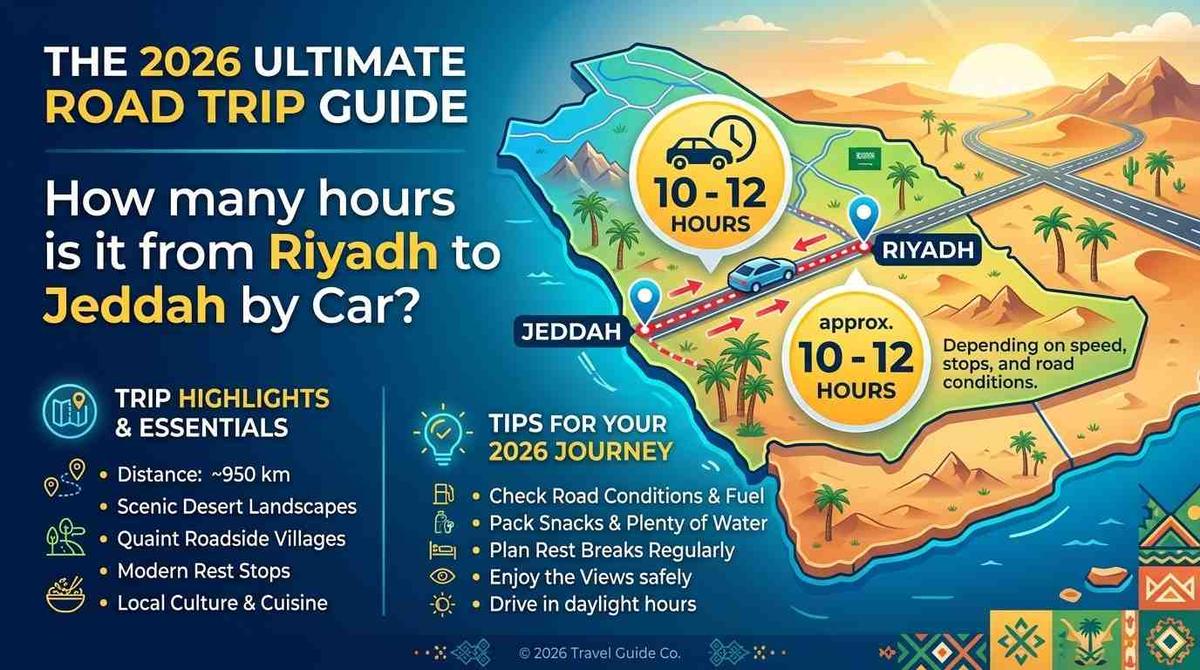
Driving from Riyadh to Jeddah typically takes between 9.5 and 11 hours, covering a distance of approximately 953 kilometers via Highway 40, depending on your average speed and the frequency of your rest stops.
The Reality of the Riyadh to Jeddah Road Trip
When you look at a map of Saudi Arabia, the stretch between Riyadh and Jeddah looks like a straightforward line cutting across the heart of the Kingdom. Having navigated this route multiple times, I can tell you that while the road is exceptionally well-maintained, it is a journey that requires respect, preparation, and a strategic mindset.
Whether you are relocating, heading to the Red Sea for a weekend, or traveling for business, understanding the nuances of this 950-kilometer trek is the difference between an exhausting ordeal and a memorable cross-country adventure.
The drive takes you from the high-altitude plateau of Najd down through the dramatic escarpments and into the humid, coastal breeze of the Tihama region. In a modern vehicle, you are looking at a solid day of driving.
Most travelers aim for the 10-hour mark, but if you value your comfort or are traveling with family, budgeting 11 to 12 hours allows for the necessary breaks that keep you sharp behind the wheel.
Key Takeaways for Your Journey
- Total Duration: Expect to spend 9.5 to 11 hours on the road under normal traffic and weather conditions.
- Primary Route: Highway 40 is the most efficient and direct path, connecting Riyadh to Jeddah via Al Quway’iyah and Zalim.
- Best Departure Time: Leaving Riyadh by 4:00 AM or 5:00 AM helps you avoid city congestion and ensures you reach Jeddah before sunset.
- Speed Enforcement: The Saher system is highly active with a general limit of 140 km/h, so consistent cruise control is your best friend.
- Strategic Stops: Plan for major fuel and food stops every 3 to 4 hours, specifically targeting reputable stations like SASCO Palm for better facilities.
Choosing Your Path: The Two Main Routes Compared
While Highway 40 is the undisputed king of this journey, your specific destination or desire for scenery might influence your choice.
I always recommend the Expressway for those who prioritize time, but the mountain pass through Taif offers a spectacular change of pace if you have an extra hour to spare.
The Expressway (Highway 40)
This is the logistical backbone of Saudi Arabia. It is a multi-lane, high-speed highway that is relatively flat for the majority of the trip. Because it bypasses many smaller towns, it allows for a very consistent pace.
It is the route I suggest for anyone focused on efficiency or those using a Riyadh to Jeddah Chauffeur Service where punctuality is the priority. The road is well-lit in many sections, but the vast stretches of desert can lead to highway hypnosis, so staying engaged is vital.
The Scenic Route via Taif
If you choose to divert toward Taif, you will eventually descend the famous mountainous zig-zag roads of Al Hada. This route adds about 30 to 45 minutes to your total time but rewards you with cooler temperatures and incredible views of the valley.
It is a fantastic option if you want to break the monotony of the desert landscape. However, be mindful that the mountain descent can be taxing on your brakes and requires more focused driving compared to the flat expressway.
Strategic Planning: Why Timing is Everything
In Saudi Arabia, the sun and the clock are your two biggest variables. I have found that a “pre-dawn strike” is the most effective way to handle this trip. By departing Riyadh at 4:30 AM, you clear the metropolitan area before the morning rush hour begins.
More importantly, you manage to cover nearly half the distance before the desert heat reaches its peak intensity.
Driving through the Nafud desert at noon can be draining for both the driver and the vehicle’s cooling system. By the time the sun is at its highest, you should ideally be past Zalim and approaching the final third of your journey.
Furthermore, arriving in Jeddah by 3:00 PM or 4:00 PM allows you to check into your accommodation and see the sunset over the Red Sea without feeling like you have lost an entire day to the pavement.
Cost Analysis and Fuel Management
One question I often hear is whether it is cheaper to drive or fly. With fuel prices in 2026, driving remains a cost-effective choice for groups or families. For a standard sedan or SUV, you can expect to fill your tank approximately two to three times, depending on your fuel efficiency.
| Expense Category | Estimated Cost (SAR) | Notes |
| Fuel (91 Octane) | 220 – 300 | Based on average SUV consumption |
| Food & Refreshments | 100 – 150 | Per person for high-quality stops |
| Tolls / Misc | 0 | Most major highways remain toll-free |
| Total | 320 – 450 | Highly economical for 3+ passengers |
Always keep your tank above the quarter-mark. While there are plenty of petrol stations, the gaps between the high-quality ones can be significant.
I personally prefer stopping at SASCO stations because they offer consistent fuel quality and cleaner restrooms, which becomes a major factor during an 11-hour commitment.
Safety First: Navigating the Saher System and Desert Hazards
Safety on the Riyadh-Jeddah highway has improved significantly over the years, largely thanks to the Saher speed camera system. On most stretches, the limit is 140 km/h for private vehicles. While it is tempting to push the limits on such wide, open roads, the cameras are precise and frequent.
Maintaining a steady 135 km/h on cruise control is the most efficient way to travel without risking heavy fines.
Beyond the cameras, you must remain vigilant for natural hazards. Sandstorms can reduce visibility to near zero in minutes. If you see a wall of dust approaching, it is better to pull over at the nearest station rather than push through. Additionally, while the highway is fenced, stray camels can occasionally be a hazard, particularly during the twilight hours. This is why I advocate for daytime driving whenever possible.
If you find the prospect of navigating these variables daunting, opting for an Executive Transfer Riyadh service can take the pressure off, allowing you to work or rest while a professional handles the logistics.
For those who prefer not to spend an entire day behind the wheel, there are premium alternatives. Using a Riyadh to Jeddah Chauffeur Service allows you to transform a ten-hour commute into a mobile office or a relaxation suite. Especially for business travelers, the ability to arrive in Jeddah fresh for a meeting, rather than exhausted from the desert sun, is an invaluable asset.
Professional services like Rideon Chauffeur Service ensure that vehicle maintenance, fuel stops, and speed limit monitoring are handled by experts, letting you focus on the journey’s purpose rather than the pavement.
Mastering the Stops: Where to Eat and Rest
One of the secrets to a successful Riyadh to Jeddah trip is knowing exactly where to stop. Not all petrol stations are created equal.
In the middle of the desert, a clean restroom and a decent cup of coffee feel like five-star luxuries. I always advise travelers to look for the “green” stations.
The SASCO Palm Advantage
The SASCO Palm stations have revolutionized road tripping in Saudi Arabia. They are generally spaced out at perfect intervals—roughly every 200 to 300 kilometers.
These locations typically feature well-known international food chains, clean prayer areas, and well-stocked convenience stores. Stopping here for 20 minutes every three hours prevents “highway hypnosis” and keeps your circulation going.
Local Flavors in Al Quway’iyah and Zalim
If you want a more authentic experience, the towns of Al Quway’iyah and Zalim offer local eateries where you can grab traditional Kabsa or fresh Bukhari rice. These stops give you a real taste of the Najd heartland.
Just be sure to check your tire pressure and fluid levels while you eat, as the heat in these central regions can be unforgiving on rubber and oil.
Preparing Your Vehicle for the Long Haul
Before you even turn the ignition in Riyadh, a mechanical audit is mandatory. This isn’t just a quick drive across town; it is nearly 1,000 kilometers of high-speed friction. I have seen many travelers stranded simply because they ignored the basics.
- Tire Integrity: Check for any cracks or “bubbles” in the sidewalls. The heat generated at 140 km/h on hot asphalt can cause weak tires to fail.
- Coolant Levels: Ensure your radiator is topped up with the correct coolant mix. The climb toward the Hejaz mountains will put your engine under significant load.
- AC Performance: A failing air conditioner in the middle of the Nafud desert is more than an inconvenience; it is a safety hazard.
- Emergency Kit: Always carry at least five liters of extra water, a basic tool kit, and a fully charged power bank.
If you are concerned about your own vehicle’s reliability, considering a Car Rental with Driver Riyadh service is a smart pivot. It guarantees you a late-model, high-performance vehicle that is specifically maintained for long-distance city-to-city transfers.
Arrival in Jeddah: The Final Stretch
As you descend from the mountains and approach the Jeddah city limits, the air changes. You will feel the humidity of the Red Sea rise, and the landscape shifts from golden sands to urban sprawling.
The final 50 kilometers usually involve heavier traffic as you merge with commuters from Makkah and the coastal areas.
I recommend having your navigation set to your specific district—whether it is the luxury hotels of the Corniche or the business hubs of Tahlia Street—well before you hit the city outskirts.
If you have timed your trip correctly, you will be pulling into the “Bride of the Red Sea” just as the city begins to wake up for its vibrant evening life.
Frequently Asked Questions (FAQ)
How many hours does it take to drive from Riyadh to Jeddah?
It typically takes 9.5 to 11 hours to drive from Riyadh to Jeddah, covering 953 kilometers. Your total time depends on your speed and the length of your rest stops.
What is the best route from Riyadh to Jeddah?
Highway 40 is the best and most direct route for travelers. It is a well-maintained expressway that connects the two cities via Al Quway’iyah, Zalim, and Taif.
Is it safe to drive from Riyadh to Jeddah at night?
Driving at night is generally safe but requires extra caution due to potential sand debris or stray animals. Many travelers prefer early morning departures to maximize daylight visibility and safety.
What is the speed limit on the Riyadh to Jeddah highway?
The speed limit for private passenger vehicles is usually 140 km/h on major sections. This is strictly monitored by the Saher camera system, so maintaining a legal speed is essential.
Where should I stop for food and fuel between Riyadh and Jeddah?
SASCO Palm stations are the most recommended stops for high-quality fuel and clean facilities. These stations offer a variety of international food chains and comfortable rest areas for travelers.
Can I hire a professional driver for the Riyadh to Jeddah trip?
Yes, you can book a Riyadh to Jeddah Chauffeur Service for a comfortable journey. Professional drivers handle the long hours of navigation while you relax or work in a premium vehicle.
What is the distance between Riyadh and Jeddah by car?
The driving distance is approximately 953 kilometers when taking the most direct route. This path takes you across the heart of the country through the Najd and Hejaz regions.
How much does fuel cost for a trip from Riyadh to Jeddah?
Fuel costs generally range between 220 and 300 SAR for a standard vehicle. This estimate varies based on your car’s fuel efficiency and the current price of 91 or 95 octane.
Is there a high-speed train from Riyadh to Jeddah?
Currently, there is no direct high-speed rail connecting Riyadh and Jeddah. Most travelers choose to drive, fly, or use the Haramain train via a connection in Makkah or Madinah.
Should I take the mountain road through Taif?
Taking the Taif route is recommended if you enjoy scenic mountain views and cooler weather. It adds about 45 minutes to your journey but offers a beautiful descent into the coastal plains.